
February 19, 2024
How to eliminate the impact of static electricity from EV battery production facilities
When you walk across a room toward the light switch, you know it's coming. You may even wince prematurely as you reach out, anticipating a jolt but hoping for only a small crackle. Sure enough… ZAP! A tiny bolt of electricity shoots from your fingertip, connects with the switch and makes you recoil.
While that relatively small discharge may be a minor annoyance to you, the release of this electrostatic charge could have major ramifications in various environments. A small electrostatic discharge could destroy computers and production equipment. It could even ignite fumes or dry powders in enclosed spaces, causing explosions and fires.
Fortunately, there is a highly effective way to keep the typically minor annoyance of static electricity from becoming a major operational or safety problem. It starts from the ground up with the installation of electrostatic dissipative (ESD) resinous flooring systems. This type of flooring is designed to drain the electrical charge that builds up in our bodies, so that no discharge occurs when a person comes into contact with an oppositely charged surface. With minimal or no charge available to release, equipment should not be affected and fumes or powders will not ignite.
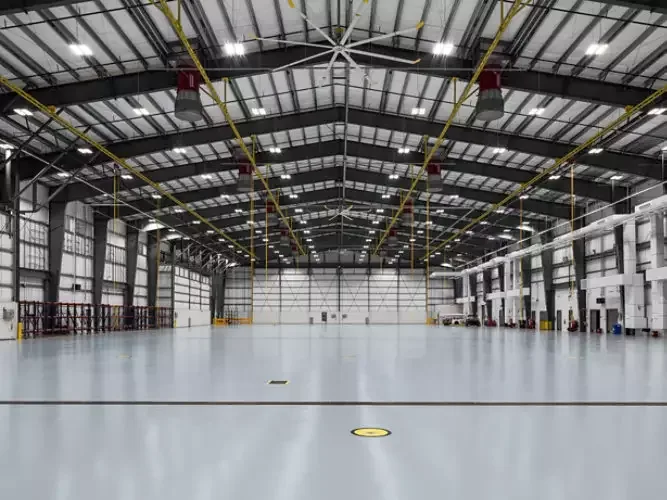
ESD flooring is required in a variety of environments to protect sensitive equipment and employees (Figure 1). It is especially important for the large number of battery facilities springing up across America to meet the growing demands of the electric vehicle (EV) market. These facilities require ESD flooring in various cleanroom-level production areas to prevent millions of dollars in damage if a static discharge were to shut down machinery or ignite fumes in wet processing areas.
With billions invested in EV battery facilities exceeding three million square feet under one roof, it is critical that ESD flooring be specified and installed correctly. This article will explain why electrostatic charges occur in the first place and how to mitigate them in critical areas using ESD flooring.
Nothing Is Shocking
Static electricity is a well-known phenomenon, from that familiar snap at the light switch to the literally electrifying experience of rubbing a balloon on your shirt and holding it near your head. It occurs when we walk on almost any surface: resinous floors, carpet, laminate, tile and more. The resulting friction causes a negative charge to build up in our bodies as electrons are transferred from the surface underfoot. We collect and store these electrons until we come into contact with a surface that contains fewer electrons. The excess electrons then jump from our bodies to the more positively charged surface, causing that all-too-familiar spark and jolt.
To even feel a static electric shock, the discharge must be a minimum of 3,500 volts. However, a discharge of just 20 volts can damage or ruin sensitive microelectronics. That is why it is so important for EV battery plants and other facilities housing sensitive electronic devices to mitigate this shock potential (Figure 2). In fact, many of these locations run facility-wide ESD programs that require specific flooring materials and complementary accessories, such as special footwear, anti-static wrist straps and mats with grounding cords. All of these control mechanisms help drain the energy stored in our bodies to ground.
Resinous ESD floors work by allowing any charge that builds up in a person walking through a room to be immediately transferred to conductive elements embedded within the flooring material and then to ground (Figure 3). This direct, uninterrupted connection can be made by embedding a copper strip within the conductive layers of the floor and connecting that strip to a metal floor beam, a steel column, the grounding terminal of an existing electrical outlet or another grounding point (Figure 4).
In EV battery facilities, ESD flooring is used primarily to protect equipment from damaging shocks and to keep facilities from catching fire. In cleanroom-level environments for battery production, high levels of filtration and low humidity levels create a dry environment with a high potential for static electricity. In such areas, a single electrostatic discharge could short-circuit sensitive battery manufacturing equipment. In addition, in wet processing areas, flammable chemicals, including the slurries and N-methyl-2-pyrrolidone (NMP) used in EV cell manufacturing, could ignite due to a spark. However, with ESD flooring properly installed in these areas, nothing is shocking, because any electrical charge is immediately dissipated to ground.
Comparing Options: Urethanes Versus Epoxies
While typical automotive production environments feature epoxy resin flooring, EV battery facilities perform better when ESD urethane flooring is specified for production areas. The main reasons include the material's installation efficiency and ease, as well as its superior durability and chemical resistance.
With epoxies, it can be more difficult and time-consuming to incorporate ESD mechanisms into the resinous material than with urethanes. In both cases, installers must create small batches of resins and mix in ESD conductive components. In addition, mixing errors have the potential to limit the floor's conductivity, leaving dead zones that do not allow charges to dissipate when pre-measured kits are not used. These dead spots are more likely to occur when using harder-to-mix epoxy formulations.
Beyond their efficiency advantages, urethane ESD flooring systems are also more durable (up to four times more wear-resistant) than epoxies (Figure 5). That includes superior scratch and wear resistance, as well as greater resistance to chemicals, including strong cleaning agents and corrosive materials such as the slurries and NMP used in battery cell production. NMP is especially aggressive and can destroy an epoxy coat within two hours of exposure, while a urethane coat can withstand the chemical for 14 days. In addition, urethane flooring systems have superior ultraviolet (UV) stability compared with epoxies, which tend to yellow and chalk under UV exposure.
Dissipating Static From the Top Down
Effective electrostatic discharge control requires the installation of a multi-layer flooring system with small strips of a grounding material that connect the floor to a permanent, uninterrupted ground. This configuration creates an electrical equipotential plane (EP), a condition in which static electricity can dissipate in any direction. While it is an excellent grounding mechanism in itself, concrete cannot serve as an EP because the air pockets, compositional variations, aggregates and other additives present in the material may not allow uniform conductivity. That is where ESD flooring comes in.
A typical ESD flooring system includes the following layers: a concrete substrate, an optional moisture mitigation layer, copper grounding tape, an ESD primer coat and an ESD topcoat (Figure 6).
Installers can apply resinous ESD flooring over new or existing concrete. They must first shot blast and grind the concrete as needed to achieve a sufficient concrete surface profile (CSP), generally 3 for urethane ESD flooring. If the concrete is new, installers can wait just seven days, rather than the traditional minimum 28-day wait for green concrete, if they apply a moisture mitigation primer. This layer seals the concrete so that moisture and air cannot outgas and cause bubbles beneath the flooring material. This primer can also be used to fill any irregularities within the concrete.
Next, installers must create a true ground through direct, uninterrupted contact between the top of the conductive floor surface and a grounding point. Copper grounding tape is recommended over copper wire due to its greater contact surface area and thinner profile. A full grid covering the entire room is not required. Instead, installers should apply a minimum of six inches of two-inch-wide copper tape onto the concrete substrate or the optional primer coat and ultimately connect that tape to an established grounding point. In general, areas should have a minimum of one grounding point per 1000 square feet of continuous space to adequately dissipate static electricity.
If there are seams in the concrete substrate, it is important to make sure that no section is isolated from electrical continuity and, therefore, from the path to ground. This may require using a Y-shaped copper strip to bridge existing joints in the concrete (Figure 7).
The installer must then test the continuity of the grounding system, following ASTM F150-06 Standard Test Method for Electrical Resistance of Conductive and Static Dissipative Resilient Flooring, to confirm that it will dissipate the required charge. Installers can perform surface-to-surface tests to verify conductivity between two metal electrodes placed 36 inches apart on the floor, using an ohmmeter to determine the point-to-point resistance within the floor (Figure 8). In addition, they can perform surface-to-ground tests by placing one electrode on the floor 36 inches from another electrode connected to the ground connection to confirm the resistance to ground.
Next, installers will apply an ESD primer coat over the grounding tape. This layer includes a variety of conductive filler components, such as carbon black or nickel-coated carbon fibers, that enable conductivity of this layer between the topcoat and the grounding tape. Again, the flooring installer must verify the conductivity of this primer coat after curing to ensure that it is less than 0.050 M ohms when tested in accordance with ASTM F150-06.
The final layer is an ESD topcoat (or topcoats) comprising conductive fillers and resin and pigment components. The conductive components complete the circuit from a person walking on the floor to the topcoat, the primer and the grounding tape below. The resin materials provide an aesthetically pleasing floor finish that is resistant to chemical attack and abrasion. After curing, a third-party engineer or electrical contractor should provide a final verification of the flooring system's conductivity. Final readings should provide an electrical conductivity leakage resistance of between 1.0 x 10⁶ ohms and 1.0 x 10⁹ ohms for an ESD floor when tested according to ASTM F150-06.
For both ESD primer and topcoat applications, it is critical that installers do not exceed the thickness specifications of the ESD materials. The conductive components added to the coatings must be accessible at the surface to complete the circuit from the floor to the grounding point. If too much material is applied, the thicker resin can shield this path and not allow electrostatic charges to dissipate sufficiently through the floor.
Ensuring Continuous Dissipation
Intermediate inspections conducted during ESD flooring installations are critical hold points that help ensure the floor can drain the specified charge from personnel working in the area. Without these checks, installers risk significant delays and expense. That is because if the floor in an EV battery facility fails the final conductivity test, it may need to be removed and reinstalled.
After installation, it is important to periodically inspect ESD floors to ensure they maintain proper conductivity. This inspection frequency may depend on the amount of traffic and wear on the floor, since heavy, repeated traffic can cause the topcoat to wear and raise the floor's electrical charge, making it too conductive. Again, an electrical contractor will be the best source for performing these tests. If readings show a trend in either direction, there are ways to stabilize the conductivity.
Floor cleanliness can also affect its ability to dissipate electrostatic charges. For example, dust, dirt, wax or even a heavy surfactant residue from a cleaning agent can create enough of a barrier between the foot and the conductive elements within the ESD floor to inhibit, or even block, the flow of electrons to a grounding point (Figure 9). This can render the ESD floor almost useless and increase the possibility of damaging electrostatic discharges. Some harsh cleaners can even destroy the conductive particles in the floor or cause them to leach out, minimizing the floor's effectiveness. Given these possibilities, facility managers will want to follow strict maintenance guidelines to ensure their floors maintain their integrity. That may include using quaternary ammonium compounds when sanitization is required, as well as softened water to keep hard water scale from shielding the floor's conductive components.
Stopping the Shock
Electrostatic discharges are not an option in EV battery manufacturing plants. Fortunately, resinous urethane ESD flooring offers a functional way to effectively mitigate their potential, protecting equipment, facilities and personnel. Compared with epoxies, the more durable and chemical-resistant urethane ESD floors better withstand the demanding environments of EV battery cell production. In addition, the floor's continuous monolithic surface eliminates the grout lines and potential weak spots found in ESD tile installations. Even so, resinous urethane ESD floors must be properly installed and frequently inspected to ensure their effectiveness. Working with knowledgeable flooring suppliers, installers and inspectors will help the entire project team achieve success from installation through ongoing operation.
ABOUT THE AUTHORS
Casey Ball is global market director for Sherwin-Williams High Performance Flooring. He previously served as Project Development Manager, drawing on his experience as a Corrosion Specification Specialist and Technical Service Representative for Sherwin-Williams after starting his career as a Laboratory Technician at General Polymers. Ball has specialized in the flooring and coatings market with The Sherwin-Williams Company for 21 years. He is a NACE-certified coatings inspector and an SSPC-certified concrete coatings inspector. He holds a bachelor's degree in business from Wilmington College and earned his MBA in marketing from Franklin University.
Eugene Geisz is global marketing director, manufacturing and processing, for Sherwin Williams Protective & Marine. He began his career as a process engineer for a pharmaceutical manufacturer before entering the coatings industry. There, over a 17-year period, Geisz has held a variety of sales and marketing roles, including business development director, global account director and regional sales director, covering the aerospace and general industrial coatings markets before taking on his current position. He holds a bachelor's degree in chemical engineering from Western Michigan University and an MBA from the Purdue Krannert School of Business.