
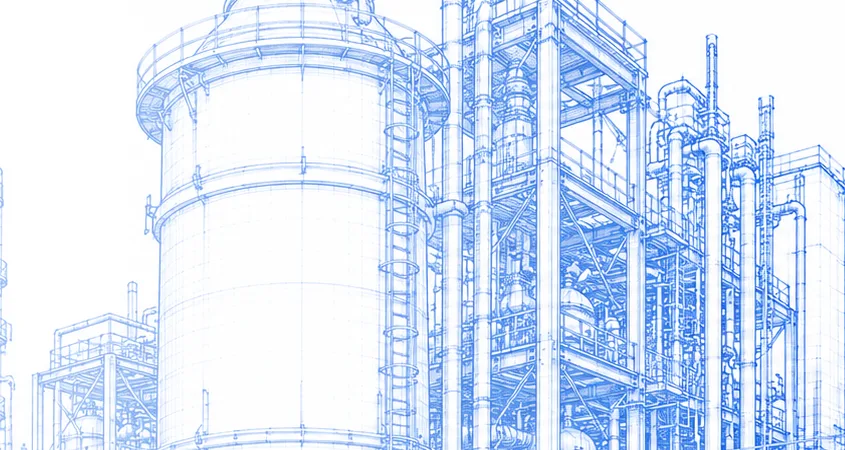
Hydrocarbon PFP
For refineries, petrochemical plants and offshore platforms - passive protection against jet fire, pool fire and BLEVE with FIRETEX® M90/02 and M90/03.
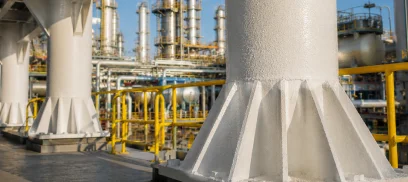
The most intense industrial fire
Fires involving hydrocarbons are incomparably more intense than cellulosic fires. A pool fire can reach 1,100°C in 3 minutes. A jet fire can hit 1,300°C with heat flux of up to 250 kW/m². The heating curve follows UL 1709 - far more aggressive than the ISO 834 curve used for cellulosic fire. In a Boiling Liquid Expanding Vapor Explosion (BLEVE) scenario, an unprotected structure can collapse in under 5 minutes. For these environments, the intumescent coating requires a hydrocarbon-specific formulation - with greater thickness, greater expansion and resistance to the mechanical flow of the fire jet. The FIRETEX® M90 systems were developed for exactly that.
Products
FIRETEX® M90/02 and M90/03
FIRETEX® M90/02
Intumescent epoxy coating for protection against hydrocarbon fires in process and offshore environments. Applied by high-pressure airless spray.
- Protection against pool fire, jet fire and BLEVE
- 30 to 120 min fire ratings depending on the system
- High resistance to abrasion and mechanical impact
- Compatible with offshore-specification epoxy primers
FIRETEX® M90/03
High mechanical strength formulation for jet fire protection - the highest heat flux scenario in refineries and platforms. Resists erosion by the gas/fire jet.
- Specific to simultaneous jet fire and pool fire
- High mechanical integrity under jet pressure
- Fire ratings verified to ISO 22899-1 / UL 1709
- For onshore and offshore applications
Scenarios
Fire scenarios covered
Pool Fire
Fire in a pool of liquid hydrocarbon. Temperatures up to 1,100°C. Occurs at tanks, piers and loading areas.
Jet Fire
A jet of flammable gas igniting under pressure. Heat flux up to 250 kW/m² - more severe than a pool fire. At valves, flanges and pressurized lines.
BLEVE
Boiling Liquid Expanding Vapor Explosion - the explosion of a pressurized vessel containing superheated volatile liquid. High explosion energy followed by a fireball.
Standards and compliance
UL 1709
Time-temperature curve for hydrocarbon fire - the basis for fire rating tests of intumescent coatings for O&G.
ISO 22899-1
Jet fire test method - verifies the mechanical integrity and performance of PFP coatings under a fire jet.
NORSOK S-001
Safety requirements for offshore installations - includes PFP specifications for O&G platforms.
API RP 2218
Recommended practice for fireproofing in refining and petrochemical facilities.
Talk to people who understand your asset, not just paint
Describe your asset's condition and the environment it operates in. Our technical team will come back with a specification aligned to the applicable standard — and the service life you expect from the system.